
Bellevue City Directory Collections on the Local Shelf
Omaha Public Library's Genealogy & Local History Room is the clearest documented place to consult the Bellevue and Sarpy County volumes. Its print run is regional, so a search can also surface Papillion, La Vista, Springfield, Offutt Air Force Base, Capehart Village, and other Sarpy-area entries. The library does not list a publisher for every Bellevue/Sarpy volume online. Inspect the title page rather than assigning a publisher from memory.
| Collection | Years | Where Held | Access |
|---|---|---|---|
| Bellevue/Sarpy County printed directories | 1963-1989; 1991-2007; 2009-current | Omaha Public Library Genealogy & Local History Room | In-room reference collection |
| Omaha city directories, print | 1866-current | Omaha Public Library | Cross-metro name and business check |
| Omaha city directories, microfilm | 1866-2001 | Omaha Public Library | Microfilm consultation |
| Sarpy Historical Society papers | 1857-1957 | History Nebraska, RG2425.AM | Finding aid first, then collection research |
The Bellevue/Sarpy sequence has two known breaks: 1990 and 2008 are not listed. It is documented through the current run, but an online inventory does not establish a first local volume, a last printed volume, or a continuous pre-1963 run.
The OPL Route for a Bellevue City Directory Search
OPL's local-history service brings several useful formats together: city and county histories, clipping files, newspapers on microfilm, family genealogies, Nebraska reference material, directories, and research databases. Its house-history guidance joins directories with deeds, tax records, maps, water permits, and census material. The water-permit material described by OPL is Omaha-specific, so it should not be treated as a Bellevue utility index. For a Bellevue connection record, ask the city water or public works office about the appropriate request path.
The Omaha Public Library Genealogy & Local History guide shows the research service behind this Bellevue city directory route.
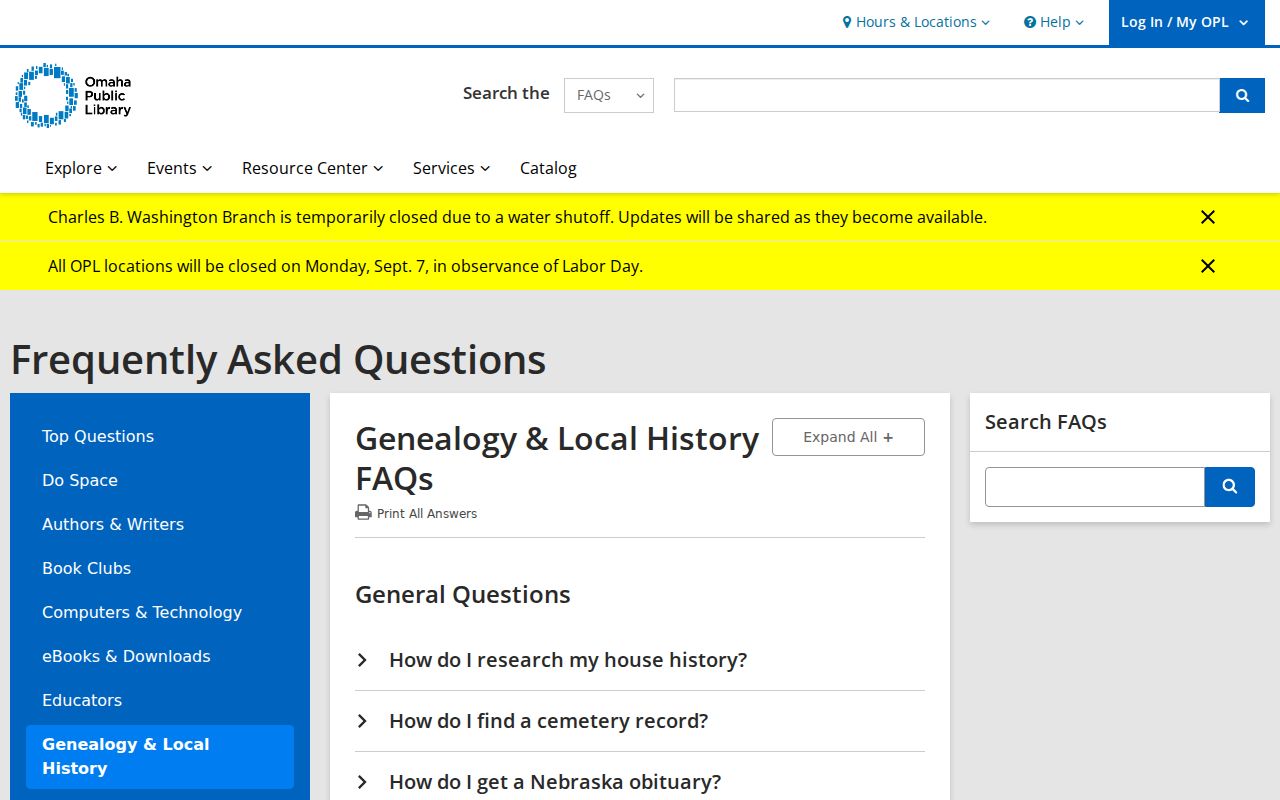
Use the library guide to plan a visit, locate companion material, or ask about an interlibrary-loan route through Bellevue Public Library. Bellevue Public Library offers research help, a microfilm reader and archive service, NebraskAccess databases, and interlibrary loan; its Ask a Librarian appointments provide another local starting point.
Bellevue City Directory Gaps and the Leapfrog Method
The two gaps in the Bellevue/Sarpy print list matter. Do not assume a person who appears in 1989 also appears in 1990, or that a 2007 address continues into 2008. OPL's Nebraska property guide recommends moving backward or forward in five-year jumps, then checking the transition year when an address or surname changes. This is a practical way to find the next known appearance without treating a directory as a census.
Before turning to the alphabetical entries, examine the title page, front matter, abbreviation key, street index, rural-route conventions, and any new-buildings pages. The same guide notes that street names can change when an area is annexed. Search an older street variant, nearby streets, and the wider Sarpy coverage when an expected entry is absent.
Omaha City Directories as a Bellevue Cross-Check
When the Bellevue/Sarpy shelf does not settle a question, OPL's Omaha print and microfilm runs offer a second metropolitan check. Bellevue households can appear in a regional telephone or business area, and a move across the metro can place a person in an adjacent directory. That cross-check is a lead, not proof that a household had a Bellevue residence in the same year.
Record the volume title and year for every result. A statewide historical-society resource also describes a directory catalog and a Gazetteer Index for 1890 and 1911, with community, business, and farmer-directory material. It does not establish a continuous Bellevue city-directory run before 1963, so cite it as a separate source rather than filling the missing years.
The OPL city-directory collection page documents the Bellevue/Sarpy and Omaha holdings used for this comparison.
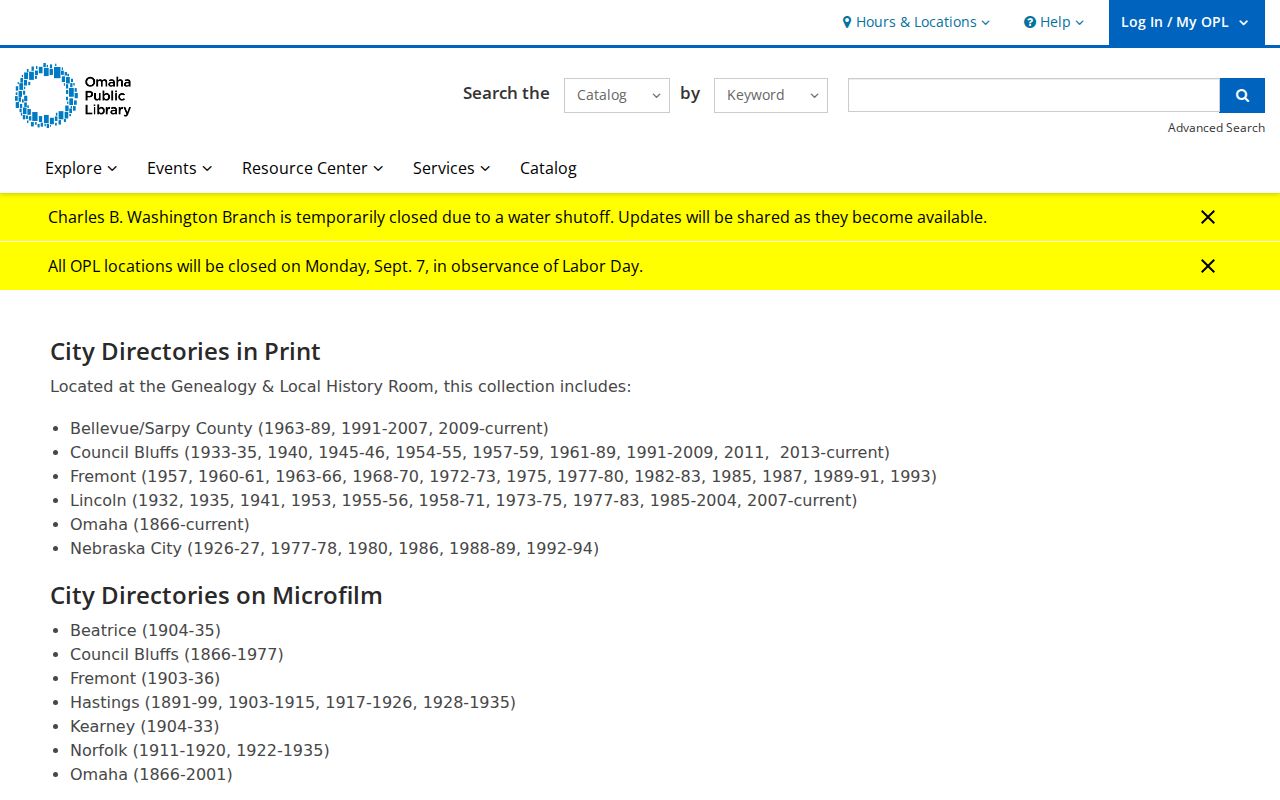
The collection image is a reminder to copy the exact run from the shelf listing. It is better evidence than labeling every local volume with an unverified publisher name.
How to Read a Bellevue City Directory Entry
A Bellevue directory entry is best treated as a compact, dated observation. The volume may list a surname and given name, spouse notation, occupation or employer, residence address, phone, a business name, room or apartment number, and symbols such as owner or renter marks. These are common fields identified by the Nebraska property guide and directory practice. A scanned Bellevue entry and its exact local abbreviation key were not inspected, so the printed key in the volume controls.
| Name | Copy spelling exactly, including initials, because it is the best bridge to newspapers and census records. |
|---|---|
| Spouse notation | Parentheses or a household notation can tie adults together; a widow notation can be a date-range clue. |
| Occupation or employer | Use it to separate same-name entries, then confirm it with another dated record. |
| Residence and phone | Capture the complete address, apartment or room number, and telephone exactly as printed. |
| Owner or renter mark | Read the volume's key first. A symbol is not a substitute for a deed or current parcel record. |
- Criss-cross section
- The reverse, street-order portion of a directory, when the volume includes one. Start with the street and house number, then read the listed occupant or business.
- Householder index
- An alphabetical path to the named household or listing. It helps turn a surname into a dated address.
- Abbreviation key
- The front or back matter that defines the volume's shorthand. Photograph or transcribe it before interpreting marks in a Bellevue entry.
Bellevue Reverse and Criss-Cross Directory Pages
For an address question, look for a reverse or street section in the particular Bellevue/Sarpy volume, then find the street and house number before returning to the alphabetical side. That sequence can identify the listed occupant or business and then add a spouse, occupation, employer, or phone from the name entry. Not every directory has the same arrangement, so its contents page and index should guide the search.
Directories are annual snapshots. They can omit children, people who requested no listing, transient residents, renters in a regional volume, and households in newly annexed or unincorporated areas. For the modern address-keyed record chain, use the Bellevue street directory once the historical volume has supplied an address.
Archive Routes When a Bellevue Directory Is Missing
Sarpy County Historical Museum at 2402 Clay Street in Bellevue is the local archive anchor. Its research holdings include district-court records from 1857 to 1971, marriage records from 1857 to 1896, naturalization records from 1857 to about 1922, local newspapers, cemeteries, churches, school material, physician records, and yearbooks. A museum research inquiry can be more productive than trying to create a nonexistent city-directory year.
History Nebraska complements that route with the Sarpy County Historical Society finding aid, a state research room, and a collections search for maps, manuscripts, government records, sound, video, and photographs. The Society papers include early land-entry copies, real-estate and election material, biographies and genealogies, a Bellevue map, and courthouse construction papers from 1858 to 1861.
The Nebraska Memories Sarpy County Historical Museum collection provides digitized photographs and artifacts with searchable metadata.
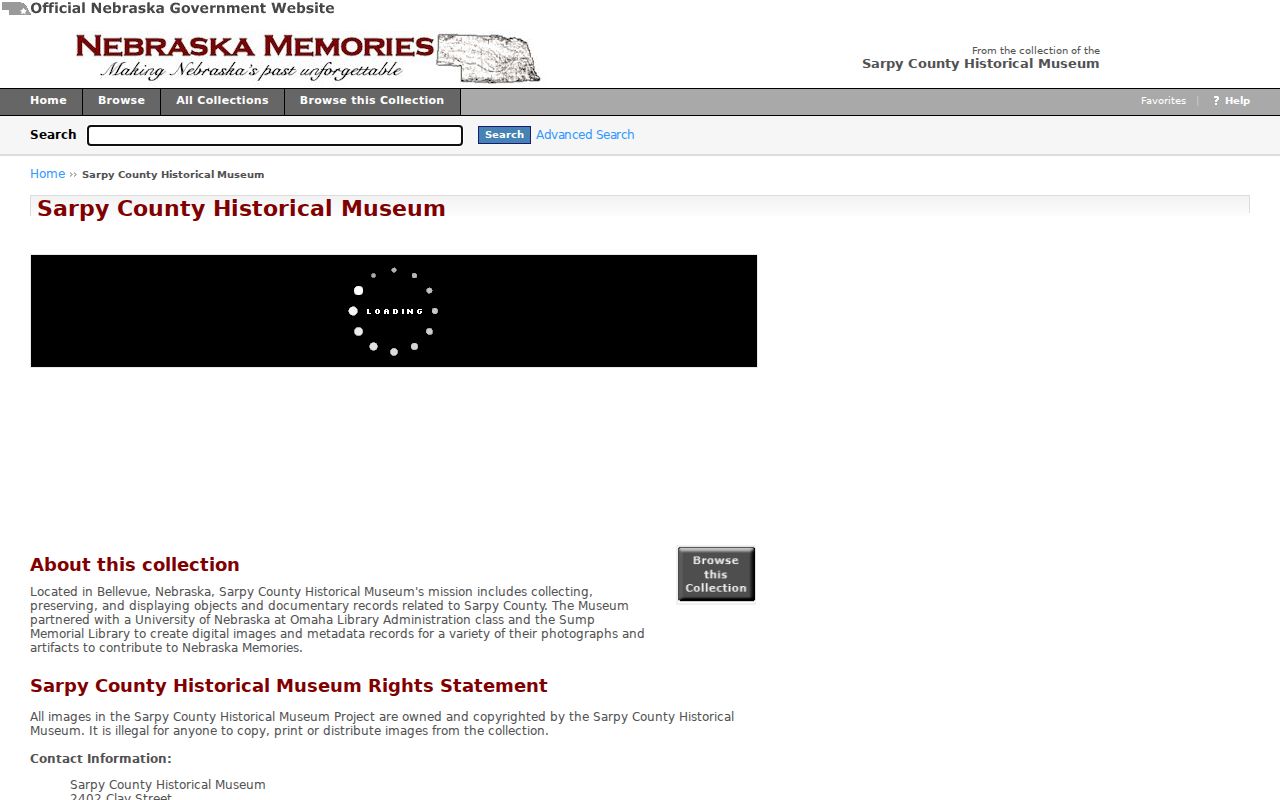
These digital objects can supply a place, organization, or date to test against a Bellevue city directory entry. The museum's rights statement applies to its images, so use the collection's stated permissions before copying or distributing them.
A Bellevue Record-Keeping Timeline
Bellevue's local paper trail predates the directory shelf. The Bellevue Palladium is listed from July 1854 to April 1855, and Bellevue Cemetery was first used in 1856. Sarpy County was organized in 1857, with Bellevue serving as county seat until the courthouse moved to Papillion on January 1, 1876. The Sarpy Historical Society was organized in 1934, while the documented Bellevue/Sarpy directory era begins in 1963.
This history explains why a research trail may move between Bellevue, Papillion, the museum, and History Nebraska. It also explains why there is no single modern database for an early Bellevue household. Local archival holdings, rather than one digitized directory, preserve the early courthouse, land, church, and family material.
Tracing a Family Through Bellevue City Directories
Use each Bellevue city directory as one point in a household timeline, then reconcile it with records that have different dates and purposes. The public federal census is available through 1950 under the 72-year release rule. A later directory may provide an address or spouse notation that helps distinguish similarly named people, but it does not replace a census household record.
- Start with a known surname, address, and approximate year in the Bellevue/Sarpy alphabetical section.
- Copy every printed form of the name, spouse notation, address, phone, and symbol, along with the volume year.
- Leap forward or backward in five-year steps, then examine the transition year when the name disappears or the address changes.
- Check the reverse or street section if present, and search old street forms or nearby streets when annexation may have changed the address.
- Pair snapshots with the 1900 through 1950 census, then use deeds, newspapers, cemetery records, and death indexes to test a move or death.
A disappearance can mean a move, death, an unlisted household, an address change, or a change in the directory's coverage. Sarpy Museum newspapers provide useful closing evidence: the Bellevue Press runs from 1945 to 1980, the Bellevue Guide from 1970 to 1979, and the Bellevue Leader from 1971 to 1993. Verify the publication title and notice date before drawing a conclusion.
Bellevue Cemetery and Newspaper Endpoints
For early Bellevue names, cemetery and newspaper evidence can close a directory trail more reliably than a missing listing. The city identifies Bellevue Cemetery as first used in 1856 and names early or notable burials including Esther Peters, John Peters, Jean Allen, Chief Big Elk, and Fenner Ferguson. A grave record can point to a death date, relationship, church, or neighborhood that warrants a fresh directory or newspaper search.
The museum's newspaper holdings also include the Sarpy County Gazette and Sun, the Papillion Times, Springfield Monitor, and Gretna titles. Search Bellevue and the historical spelling Belleview, as well as Papillion, Offutt, Capehart, a subdivision name, or a lot and block when the city-directory wording does not match a later record.